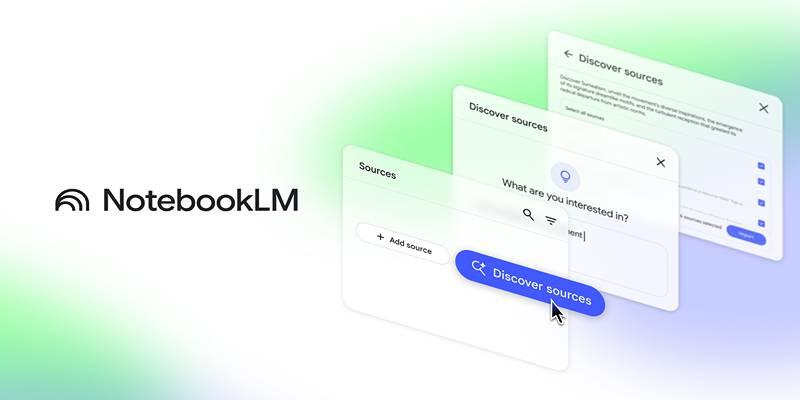
In an era marked by rapid digital transformation and an overwhelming influx of online content, the need for smarter, more intuitive research tools has become increasingly apparent. NotebookLM, Google’s AI-powered research and note-taking assistant, has taken a strategic step in this direction with the launch of its Discovery Sources feature.
This feature is designed to enhance the user’s ability to find, evaluate, and comprehend information more efficiently. It transforms traditional search behaviors by offering curated, annotated content directly tied to a user’s inquiry, thereby eliminating the noise and inefficiencies of manual searching.
The Purpose Behind Discovery Sources
NotebookLM’s Discovery Sources feature was built to solve a common problem in the digital age—how to access meaningful content without being drowned in irrelevant or low-quality material. Whether users are conducting academic research, preparing for a presentation, or simply exploring a new subject, they often find themselves overwhelmed by the volume of information available online.
Discovery Sources minimizes this friction by serving as a context-aware research assistant. Instead of leaving users to sift through endless lists of search engine results, the tool identifies up to ten relevant online sources and provides a concise annotated summary for each. These summaries present core ideas, allowing users to assess content quickly and accurately.
How Do Discovery Sources Work?
The functionality of Discovery Sources lies in its combination of machine learning, natural language understanding, and curated content delivery when a user provides a brief description of a topic, NotebookLM processes that input to interpret not only the keywords but also the user’s intent.
The system then scans a wide spectrum of web-based materials, including reputable articles, studies, and blog content. From this pool, it selects sources that are contextually appropriate and provides a summarized overview of each. These annotations aim to highlight the most valuable aspects of the content—key insights, arguments, and takeaways—thus reducing the cognitive load on the user.
Importantly, the summaries are not direct excerpts but synthesized insights crafted to convey meaning in a user-friendly format. It helps users engage more thoughtfully with content, even before deciding to read the full source.
Designed for Efficiency and Depth

What sets Discovery Sources apart is its focus on efficiency without compromising depth. Traditional search engines often require users to open multiple pages, skim through content, and determine relevance on their own. NotebookLM removes much of that guesswork.
The interface allows users to view annotated insights at a glance, compare different perspectives, and build a clearer understanding of their topic. It is particularly beneficial in time-sensitive environments where fast, accurate insights are critical. For students, journalists, educators, and professionals alike, the ability to cut through superficial data and access meaningful context quickly is an invaluable asset.
It empowers users to shift their focus from endless searching to actual learning and content creation. With Discovery Sources, every query becomes a gateway to well-structured knowledge, not just information.
Encouraging Curiosity with a Playful Twist
Alongside the structured research capabilities, NotebookLM introduces a lighthearted and exploratory feature—the “I’m Feeling Curious” button. This function generates a selection of sources on random or trending topics, complete with summaries, offering users an engaging way to stumble upon new ideas or dive into unexpected subjects.
While seemingly whimsical, this feature supports a deeper principle: learning through discovery. It encourages spontaneous curiosity, helping users engage with unfamiliar topics that may spark inspiration, cross-disciplinary insights, or new areas of interest.
By blending exploration with intelligent curation, NotebookLM turns casual browsing into an enriching educational experience. It’s a gentle nudge toward serendipitous learning in an increasingly structured digital world.
User-Centric Design and Accessibility
NotebookLM’s Discovery Sources is designed to be accessible to a wide range of users. There is no technical setup required; the feature is fully integrated into the existing NotebookLM interface. Once it becomes available to all users—as part of a phased rollout—it will require only a simple text input to begin generating results.
This simplicity masks a powerful backend. By prioritizing usability, NotebookLM ensures that anyone—regardless of research background or technical ability—can benefit from AI-driven assistance. Whether a high school student exploring biology or a business analyst studying market trends, users can engage with content in a smarter, more structured way.
Impact on Modern Research Habits

The rise of AI tools is reshaping how individuals approach knowledge acquisition. NotebookLM’s Discovery Sources aligns with a growing trend: the move away from search-based exploration toward assisted understanding.
Rather than relying solely on keyword matching, Discovery Sources prioritizes contextual relevance. It understands nuances in user intent and delivers information that aligns with the broader meaning behind queries. It aligns more closely with how human research assistants operate—analyzing not just what is asked but why.
For knowledge workers, this represents a shift in workflow. Time previously spent evaluating links and scanning web pages can now be directed toward deeper analysis, idea development, and content creation. It enhances productivity while supporting more informed decision-making.
Supporting Critical Thinking and Content Evaluation
In addition to saving time, Discovery Sources encourages critical engagement with content. The annotated summaries serve as conversation starters, prompting users to consider which sources are most aligned with their goals, how perspectives differ, and which arguments are most compelling.
It is especially useful in educational contexts, where students often struggle to evaluate the reliability and relevance of sources. NotebookLM’s approach teaches users to interpret and assess information rather than passively consume it. As a result, users build not only knowledge but also analytical skills.
Conclusion
The introduction of Discovery Sources marks a significant milestone in the evolution of intelligent research tools. By combining curated content, summarized insights, and user-centric design, NotebookLM delivers a more refined, purposeful research experience.
Instead of overwhelming users with excessive information, it guides them toward clarity and comprehension. The result is a more productive, engaging, and insightful approach to learning and discovery—one that matches the needs of modern users navigating a vast digital landscape.