In a digital environment where privacy and data control are critical concerns, Cryptomator Hub has become a trusted name in client-side encryption and secure file collaboration. With the release of version 1.4.0, the platform introduces significant improvements, most notably the Web of Trust model, which enhances identity verification and strengthens user confidence in shared encrypted environments.
This update also includes a range of refinements in access control, audit logging, key management, and system usability—each contributing to a more secure and transparent user experience. The goal of Cryptomator Hub 1.4.0 is not simply to make encryption more robust but to make security verifiable, scalable, and manageable across diverse organizational structures.
A Major Step in Decentralized Trust: Web of Trust
The core highlight of Cryptomator Hub 1.4.0 is the integration of a Web of Trust (WoT) model—a decentralized identity verification system designed to replace sole reliance on centralized authorities or administrators.
In traditional access control systems, trust is often issued top-down. One central entity manages all key verifications and identity assurances. In contrast, the Web of Trust distributes that responsibility across users, allowing trust to be established organically through peer verification and key validation chains.
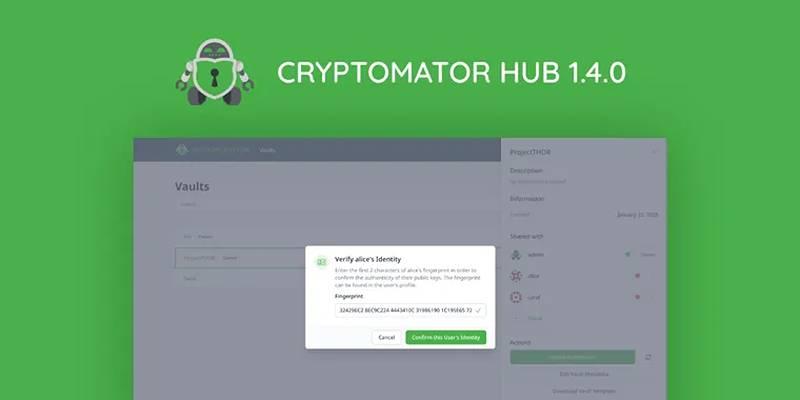
Within Cryptomator Hub, the WoT feature enables users to view and verify the authenticity of public keys belonging to other collaborators. A user can explicitly trust another person’s key or rely on intermediate validations where a mutual connection has already established trust. This layered approach mirrors real-world trust relationships and introduces flexibility in managing collaborative file access.
This model empowers users by reducing dependency on a single point of control, helping prevent unauthorized access and identity spoofing, particularly in decentralized or remote-first teams.
Strengthened Public Key Management
Building on the Web of Trust, version 1.4.0 significantly improves how public keys are handled, verified, and visualized. Due to complexity or insufficient tooling, key management is often a weak link in many encryption systems. Cryptomator Hub addresses this by making key relationships and trust paths more transparent and navigable.
Users can now view detailed trust relationships, including who has verified whom and how those trust links affect access to encrypted vaults. This functionality helps users and administrators detect potential issues, such as expired or unverifiable keys, and proactively take corrective action.
Moreover, the key verification interface has been redesigned for clarity. Instead of relying on command-line actions or manual comparisons, users can manage key confirmations directly through the Hub’s visual interface, reducing the barrier to secure collaboration.
Role-Based Access Control Enhancements

Another critical aspect of version 1.4.0 is its Role-Based Access Control (RBAC) expansion. While Cryptomator Hub already supported basic role assignments in earlier versions, this release deepens the functionality by offering more granular control over vault permissions and group access rights.
Administrators can now define detailed access roles at various levels—including vault-level and organization-wide—and enforce them precisely. These refined controls ensure that users only have access to the data necessary for their responsibilities, following the principle of least privilege.
Additionally, permission inheritance and conflict resolution have been improved. It ensures overlapping roles or user group assignments do not unintentionally escalate privileges.
Transparent Audit Logs and Event Monitoring
Security is not just about prevention—it’s also about accountability. With that in mind, Cryptomator Hub 1.4.0 introduces comprehensive improvements to its audit logging system. Every major event, from access changes and key verifications to vault creations and role modifications, is now recorded in a structured, tamper-evident format.
This feature gives organisations complete visibility into how data and trust relationships are managed. Logs can be searched, filtered, and exported for further analysis, making detecting anomalies, investigating incidents, and satisfying compliance requirements easier.
These detailed audit trails are essential for businesses operating under regulatory mandates—such as GDPR, HIPAA, or ISO 27001.
Improved User Experience and Interface Design
Alongside backend security improvements, Cryptomator Hub 1.4.0 introduces notable updates to its user interface, ensuring that critical features are accessible even to users without deep technical expertise.
The onboarding experience for new users has been streamlined, allowing for smoother invitations, more precise instructions for public key exchanges, and guided verification of trust relationships. Admin dashboards now display real-time summaries of vault statuses, key health, and user access, reducing the time required to manage teams effectively.
This focus on usability aligns with Cryptomator's long-standing goal of making strong encryption accessible. Rather than forcing users to choose between security and simplicity, this release offers both—integrated in a way that complements routine workflows rather than disrupting them.
Performance Optimizations and Backend Scalability
Cryptomator Hub 1.4.0 also delivers under-the-hood performance enhancements to support large organizations and high-frequency usage scenarios. Server-side operations, including vault indexing, user synchronization, and key processing, now execute more efficiently thanks to improved caching and optimized database queries.
It translates to better responsiveness across the platform. Operations that previously introduced noticeable delays—such as mass role updates or trust chain recalculations—now execute with minimal latency.
Scalability has also been a focus in this release. Organizations with hundreds or thousands of users will benefit from architectural improvements that ensure stability under load, paving the way for broader enterprise adoption.
A Solution for Security-Conscious Collaboration

As organizations continue shifting to cloud-based collaboration tools, the need for end-to-end encryption and user-verifiable trust models becomes more critical. Cryptomator Hub 1.4.0 is designed to meet that need, offering features combining cryptographic rigour and operational flexibility.
The introduction of the Web of Trust system marks a forward-thinking approach to digital identity management. At the same time, the improved auditability and access control features give administrators the tools needed to manage complex teams securely.
Conclusion
Cryptomator Hub 1.4.0 is a landmark release that blends powerful trust-based security mechanisms with user-friendly design and enterprise-level scalability. The addition of the Web of Trust model significantly improves how identity and encryption are managed. At the same time, enhancements in access control, auditability, and performance reflect a thoughtful evolution of the platform.
For organizations seeking secure, collaborative file sharing without compromising on control or usability, Cryptomator Hub 1.4.0 delivers a compelling, future-proofed solution—placing trust, transparency, and control back into the hands of users and teams.